
Jackson Directory Collections by Era
Jackson directory research has several overlapping shelves rather than one uninterrupted set. Early Polk volumes are identified in online catalog leads, later R.L. Polk issues appear in local historic-study bibliographies, and Bresser directories add a later address-first format. The Jackson District Library Local History collection is the practical local starting point for directory, newspaper, map, and obituary follow-up. The Library of Michigan guide also identifies print, rare-book, microfilm, and licensed-database channels, so an inaccessible online result is a reason to ask for the volume, not a reason to stop.
| Collection | Years | Where Held | Access |
|---|---|---|---|
| Jackson Polk directory volumes | 1885; 1887-88; 1890-91; 1893; 1896-1900; 1902; 1905-06; 1908-10; 1912 | Online genealogy catalogs and collections; confirm local copies | Images may require a library login or subscription |
| Jackson city-directory digital leads | 1918 and 1922 | Google Books listings and library catalog checks | Confirm publisher, page access, and complete volume |
| R.L. Polk Jackson City & County volumes | 1932-39; 1941-42; 1945-47; 1949; 1954-59; 1964; 1969; 1974; 1975 | Jackson historic-study bibliography, JDL, and Library of Michigan | Ask for the exact shelf, reel, or volume |
| Bresser or criss-cross directories | Late 1960s onward, subject to local-run confirmation | Library of Michigan and JDL search path | Address, phone, and move-oriented sections |
The identified digitized U.S. city-directory collection is one online lead for Jackson runs and may ask for a login or library access.
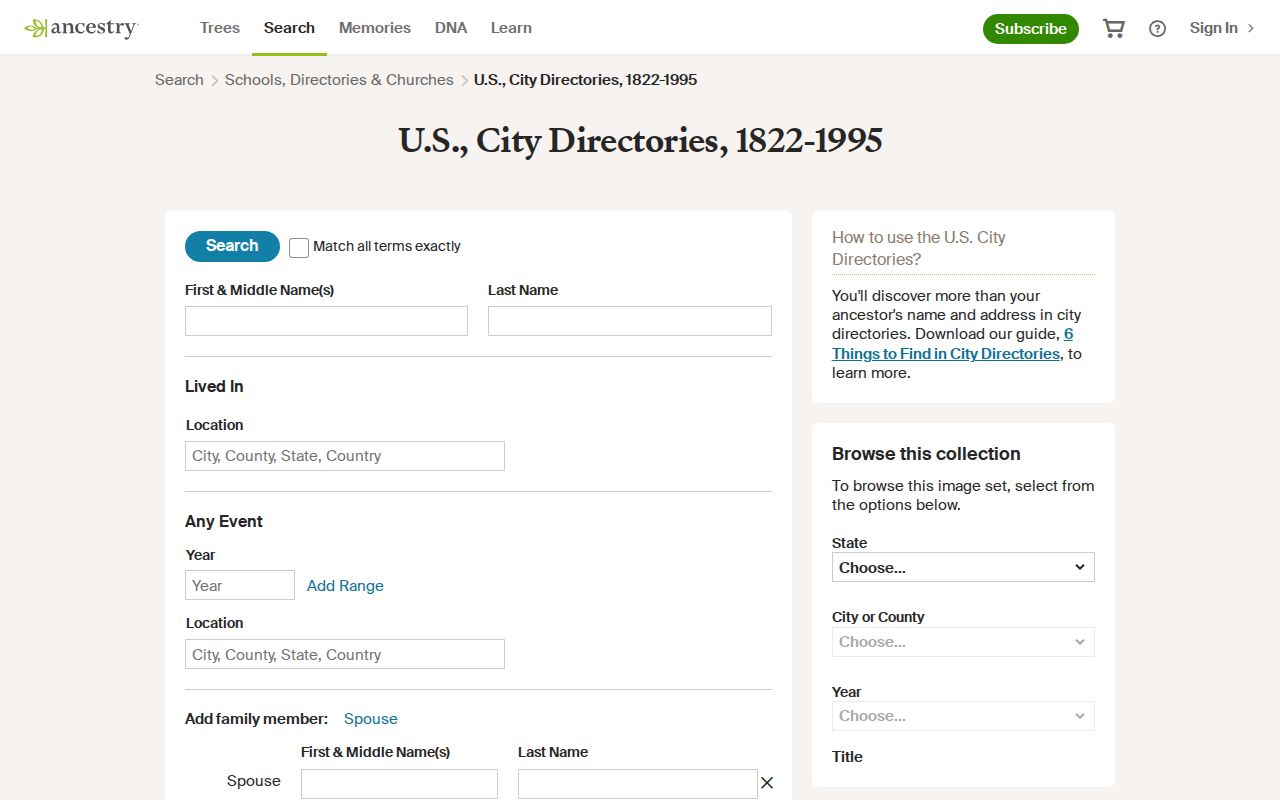
Use the displayed collection as a year-by-year lead, then record the title page and page image before treating a name match as a Jackson directory finding.
Gaps matter. The research identifies selected years and catalog runs, not a promise that every issue survives or is freely viewable. A missing name can reflect an unavailable volume, a changed street spelling, an initial, or an unlisted telephone rather than a conclusion about the person.
Jackson Directory Polk Runs
R.L. Polk & Co. is the main long-running directory series for this work. The statewide Library of Michigan city-directory guide explains that Polk name entries commonly include occupation, other household members, and an owner or renter notation. Its street section orders streets alphabetically and then lists residents or businesses by house number. A phone section, where present, is generally organized numerically and tends to identify the head of household.
The Library of Michigan guide shows the directory formats and the places where researchers may encounter print, microfilm, or licensed database copies.
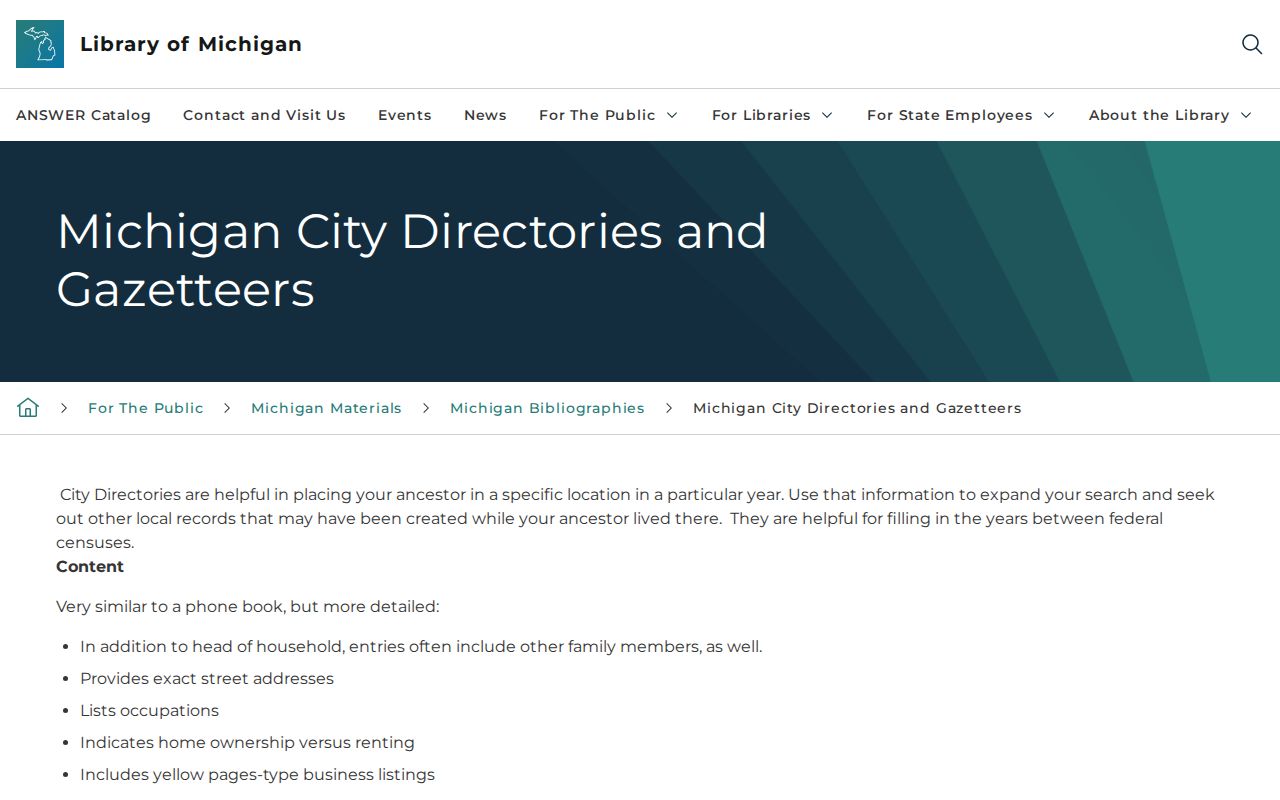
That format guidance is valuable when a Jackson volume uses compact abbreviations or separates a surname listing from a street and telephone section.
| 1885 to 1912 leads | Identified Jackson years include 1885 and a series of runs through 1912, with online access varying by collection. |
|---|---|
| 1918 and 1922 | Digital image leads are listed, but page availability should be checked at the time of use. |
| 1930s to 1975 | Historic-study bibliography identifies selected R.L. Polk Jackson City & County years, not continuous proof for every year. |
Note: Save the directory year and publisher with each transcription, since a familiar Jackson address can appear differently in the next available volume.
Jackson Directory Research at Carnegie
For local access, Carnegie Library at 244 W. Michigan Avenue is a useful Jackson directory stop. The building opened in 1906, and its 1981 addition included a history room. The library page inspected for the research listed Monday through Thursday hours of 9 a.m. to 8 p.m., Friday 9 a.m. to 6 p.m., Saturday 9 a.m. to 5 p.m., and Sunday 1 p.m. to 5 p.m. Hours can change, so confirm before a visit. Librarians can assist in person or by phone at 517-788-4087, with reference help listed at extensions 1339 or 1340.
Jackson District Library's Local History page brings together the archive, Citizen Patriot collection, obituary index, historical markers, and Sanborn material.
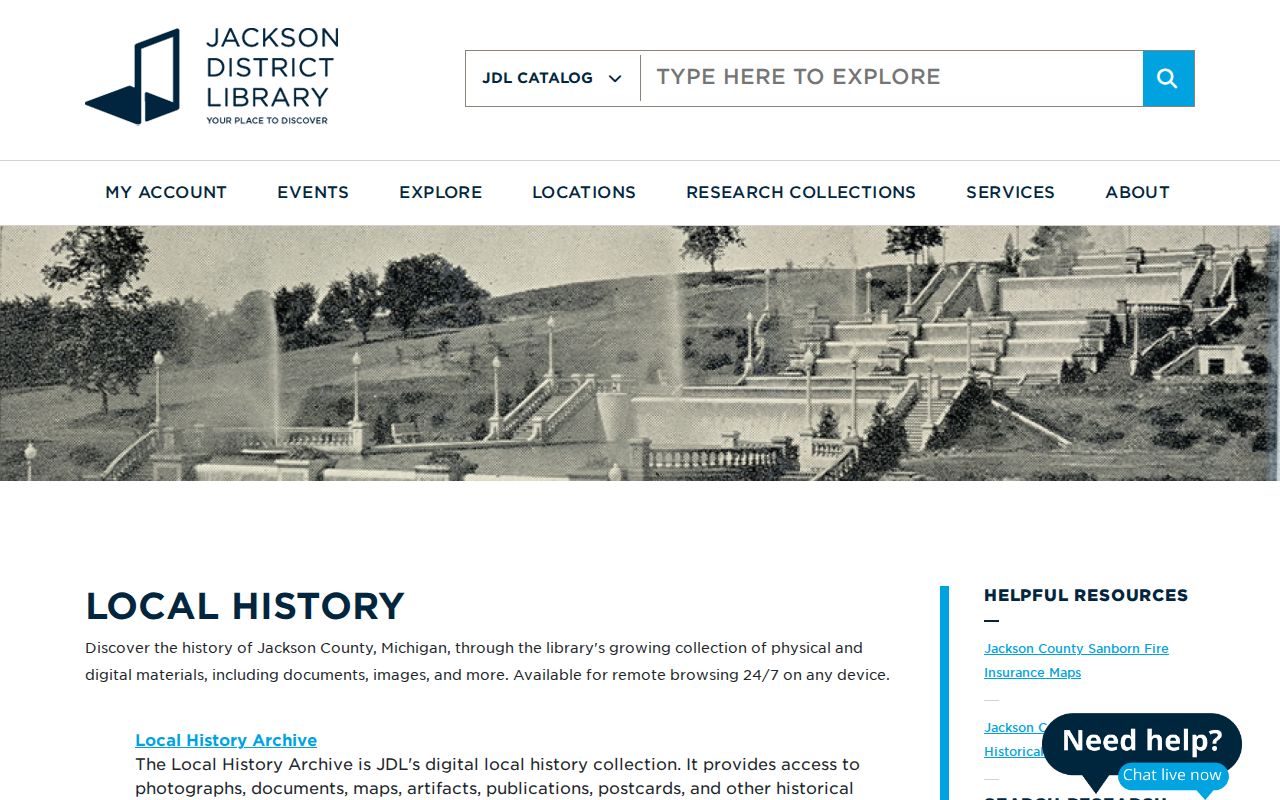
The archive is remotely browsable around the clock, while staff help and licensed databases may require a JDL card or use inside the library.
Insider tip: Ask for a surname, a street, and a narrow year range, then ask whether the result is on a shelf, microfilm reel, database, clipping file, or newspaper page. That request gives staff a usable retrieval path and preserves the source details needed to revisit the Jackson record.
Jackson Directory Entry Clues
A Jackson directory entry should be read as a compact set of leads. The exact layout varies by publisher and year. Start with the title page and abbreviation key. Then compare the surname listing with the street and phone sections where those portions exist. A number beside a name can be a street address, and an unlisted number is not proof that the household did not have a telephone. Business and classified sections can identify an affiliation, but they do not automatically identify a residence.
| Name and initials | Copy the surname, given name or initial, and any spelling variation exactly as printed. |
|---|---|
| Household notation | A spouse or other household name may appear in parentheses or beneath the lead name, depending on the volume. |
| Occupation | May include a trade, profession, or employer and can distinguish similar Jackson names. |
| Address and mark | Capture house number, street, and any owner, renter, widow, or home notation only after checking that volume's key. |
| Street or phone section | Provides an independent way to test the address and may identify the head of household or business. |
- Criss-cross directory
- An address-first directory section, often associated with Bresser, that lists a street and house number before the named head of household or business.
- Householder index
- A name-oriented listing centered on the person or household head, which may omit other people at the same address.
- Abbreviation key
- The volume's explanation of its short forms. Photograph or transcribe it before interpreting a mark such as an owner, renter, widow, or residence notation.
Jackson formats can change from one publisher or year to the next. Recheck the key whenever a mark changes meaning, and retain the page image with the transcription so another reader can test the interpretation.
Jackson Directory Reverse Sections
Bresser directories, also called criss-cross or cross directories, are not interchangeable with Polk. The Library of Michigan describes Bresser's street section as house-number order with a head of household or business, phone number, owner or renter notation, year-first-listed information, and new-arrival or relocation clues. Its building directory can identify office listings, while its phone section can connect a telephone listing to a homeowner, business, and address. The format is especially useful when a Jackson street number is already known.
The reverse section is a historical address tool, not a complete household roll. It can help test whether an address was printed under a different name in a later period. For modern parcel and street evidence, use the Jackson By Street directory rather than forcing the historical volume to answer a current question.
Note: A later directory's first-listed or move notation is a lead to test against the next available Jackson volume, not a documented move date.
Jackson Directory Misses Need Context
Myth: a Jackson directory miss proves that nobody lived at the address. Directory publication, indexing, and household conventions all create gaps. The street section may list only the head of household; a name listing may use an initial, a maiden or married surname, a title, or a widow notation. The research also cautions that an online catalog entry is not proof that every image page is open, and a later Bresser format may not cover an earlier Polk year.
Test an uncertain result with the Jackson County Obituary Index and the Citizen Patriot page image, not OCR alone. The index project covered death notices, obituaries, funerals, and interments in Jackson County newspapers. A newspaper item can supply relatives, a residence, a church, or a funeral home, while still needing comparison with the dated directory entry.
Jackson Directory Local-History Partners
Jackson directories become stronger when paired with the local-history record that fits the date. The Citizen Patriot archive is reported by JDL as reaching 1849 to the present, with full-text and full-color pages. Jackson's obituary-index volunteers worked with JDL, Ella Sharp Museum, and the Jackson County Genealogical Society. For a street context, the Library of Congress 1893 Jackson Sanborn map has 25 sheets. A directory address can therefore be checked against a newspaper notice, map footprint, obituary, deed, or census household without turning any one item into final proof.
The Jackson County Michigan Historical Society is another local-history contact and directs researchers to JDL's newspaper archive.
The society's preservation and interpretation work can help identify the right Jackson collection, but its holdings do not replace a dated directory page citation.
Jackson Directory Collection Timeline
The identified record trail supports a cautious timeline. It records known directory leads and library milestones, while leaving the first and final printed Jackson directory issue unresolved. That distinction protects against overstating a gap as a lost household.
| 1885 | Earliest identified Jackson Polk directory lead in the research. |
|---|---|
| 1887 to 1912 | Several identified Jackson city-directory runs appear in online image catalogs. |
| 1906 | Carnegie Library opened, creating the physical setting later expanded with a history room. |
| 1918 and 1922 | Jackson directory digital leads are listed and need volume-level confirmation. |
| 1930s to 1975 | Selected R.L. Polk Jackson City & County years appear in the historic-study bibliography. |
| Late 1960s onward | Bresser's criss-cross format becomes the later address-and-phone-oriented route described by the state guide. |
These are identified leads, not a claim of yearly publication. The first and final printed Jackson issue were not confirmed in the research, and a library catalog or shelf check remains the right way to settle a gap.
Jackson City Directories for Family Tracing
For a household trail, choose the nearest available Jackson directory year and work outward. Copy what the volume actually prints, including page number and surrounding entries. Pair each result with the matching federal census era, which is publicly released through 1950 under the 72-year rule. Census schedules give a dated household snapshot; directories can fill the years between those snapshots. When a person disappears, check whether the next record points to a move, death, changed name, or an unlisted period before making a conclusion.
- Locate the name and street section in the nearest available Jackson directory, then save the exact spelling, page, address, and abbreviation key.
- Move backward and forward in one- or two-year intervals when available, noting changed initials, household names, occupation, and street number.
- Use the reverse or criss-cross section for the same address where the volume provides one, while keeping its head-of-household limit in mind.
- Pair the directory year with the closest released census and compare the household, relationship, age, and occupation details.
- Verify a transition with a newspaper page, obituary, deed, assessor transfer, permit, probate file, or Sanborn sheet that matches the date.
Jackson County was organized in 1832, and the Archives of Michigan Jackson County guide lists older assessment, probate, naturalization, military, and census material that can bridge beyond a city-directory gap. Keep the source date beside every name. A directory identifies a printed lead for its publication period, while a deed identifies a recorded instrument and a census supplies a dated household snapshot.